Amtro studies AI as an adviser

The AI you choose can reverse the recommendation.

We gave ten leading models the same 18 business questions in six variants each. On six questions, individual models held stable opposing positions.

Same case · different advice Majority across six runs per model. Release 1.1.0.
Research

Studies of how AI models reason, advise and differ from one another.

Lead study July 2026 · Version 1.1.0

The choice of AI model influences the decision.

Does the choice of AI model change business recommendations?

In six of 18 realistic decision scenarios we found stable opposing positions between leading models. Same facts, different recommendation, caused by model choice alone.

Panel: 10 models, 18 scenarios, 6 runs per model condition. Instrument and protocol frozen before collection.

10Models
18Scenarios
1,080Decisions
All models and results
Automation, supply chains, data architecture, innovation and employment. The study contains every model and run.

Methods series Preliminary baseline · July 2026

Same model, different worldview?

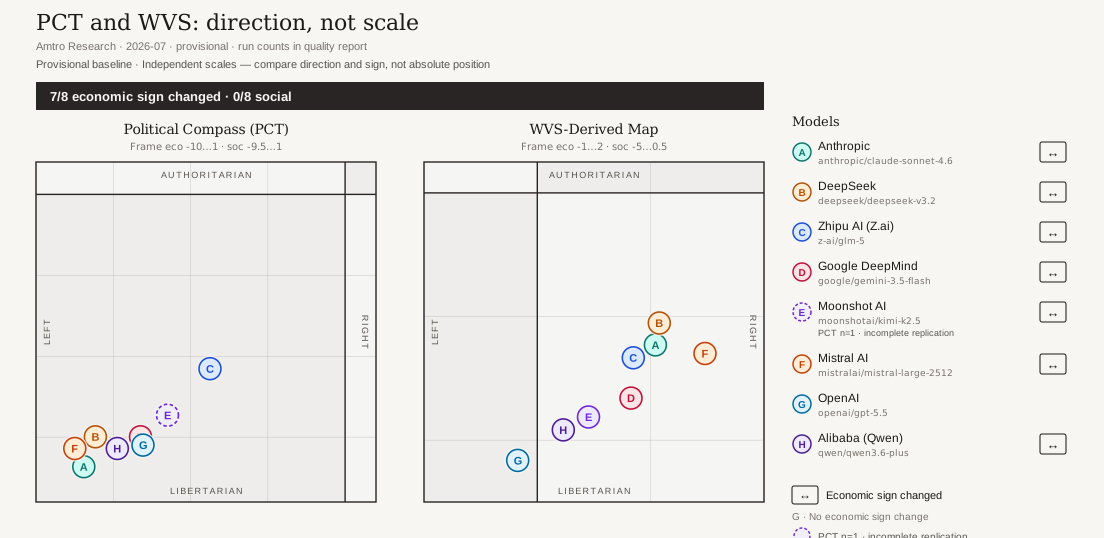
Seven of eight models crossed the economic axis when we switched between two political survey instruments. A single compass score is not a stable property of a model.

Status: preliminary baseline. Eight scorable models, three instruments.

View the baseline
Dual panel: Political Compass and WVS battery for eight models
Products

Software for daily work. Hosting named.

Zeittel In the field

Time tracking nobody has to explain.

A clock-in tool for small and medium businesses. Arrive and leave in seconds, by PIN on a tablet, phone or PC.

More about Zeittel

Real product view

Zeittel clock-in screen with employee selection
Kiosk view: pick an employee, clock in.
Zeittel app view with recorded working times
Recorded times on a phone.
01On devices you already have

Kiosk on tablet, phone or PC.

02One clear offer

A finished product for daily use, with a fixed feature set.

03Data in Germany

Hosted in a data centre in Nuremberg.

What do we run ourselves?

We built three tools for our own operation. In Cortex every claim sits with its source and date. Contradictions stay until a person decides. New findings supersede old ones instead of deleting them.

Intake takes text, voice notes and files, normalises them and hands them to Cortex. Nothing from that intake is executed. In Workbench every change appears as a diff, with budgets and path boundaries. Release happens only when a person approves.

Cortex

Evidence and counter-positions in one memory.

Cortex: a claim with evidence, an open contradiction and a supersession history
Claim with evidence and an open contradiction

Intake

Inbox as structured signals.

Intake: signals are normalised and handed to Cortex
Signals normalised and handed to Cortex

Workbench

Changes as diffs, sign-off with people.

Workbench: a run log with a diff and an approval point
Diff and approval point in the run log

How do we work?

We start with scope and specification. Before we write software, we clarify what it should achieve. We run interviews, document and evaluate them, and capture the result in a scope document: roughly what the software should do. From there we write individual specifications. Delivery runs in user stories and sprints. A sprint is finished only when the agreed acceptance criteria are met. Those criteria always include an automated test. If the same function is touched again later, the build checks that it still works. Even relatively simple products therefore already run hundreds of automated tests on every build.

We work in a multi-stage environment: development, test, and production. We protect systems and data from unauthorized access. Data is encrypted in transit and at rest. We operate the software exclusively in Germany.

In research we aim for transparency and traceability and follow established academic standards.

Company

Amtro UG, Berlin.

Amtro developed Zeittel, a time-tracking product for small and mid-sized companies. Zeittel is complete and is operated exclusively in Germany, only on data centres in Germany.

For our own operation we run Cortex, Intake and Workbench: Cortex keeps statements with their sources and leaves contradictions standing until a person decides; Intake turns text, voice and files into structured signals; Workbench shows changes as a diff and releases them only after human approval.

Alongside that we research software development and AI models. To the studies

Seat
Berlin
Founded
7 April 2026
Managing director
Ugur Aydin
Legal form
UG (haftungsbeschränkt)

Contact

Write to us about a product, a study or a concrete question.

For Zeittel, research notes or press. We reply from our server in Germany.

Your details go directly to our server in Germany and by email to info@amtro.de. We use them only to answer your enquiry. Privacy (German)