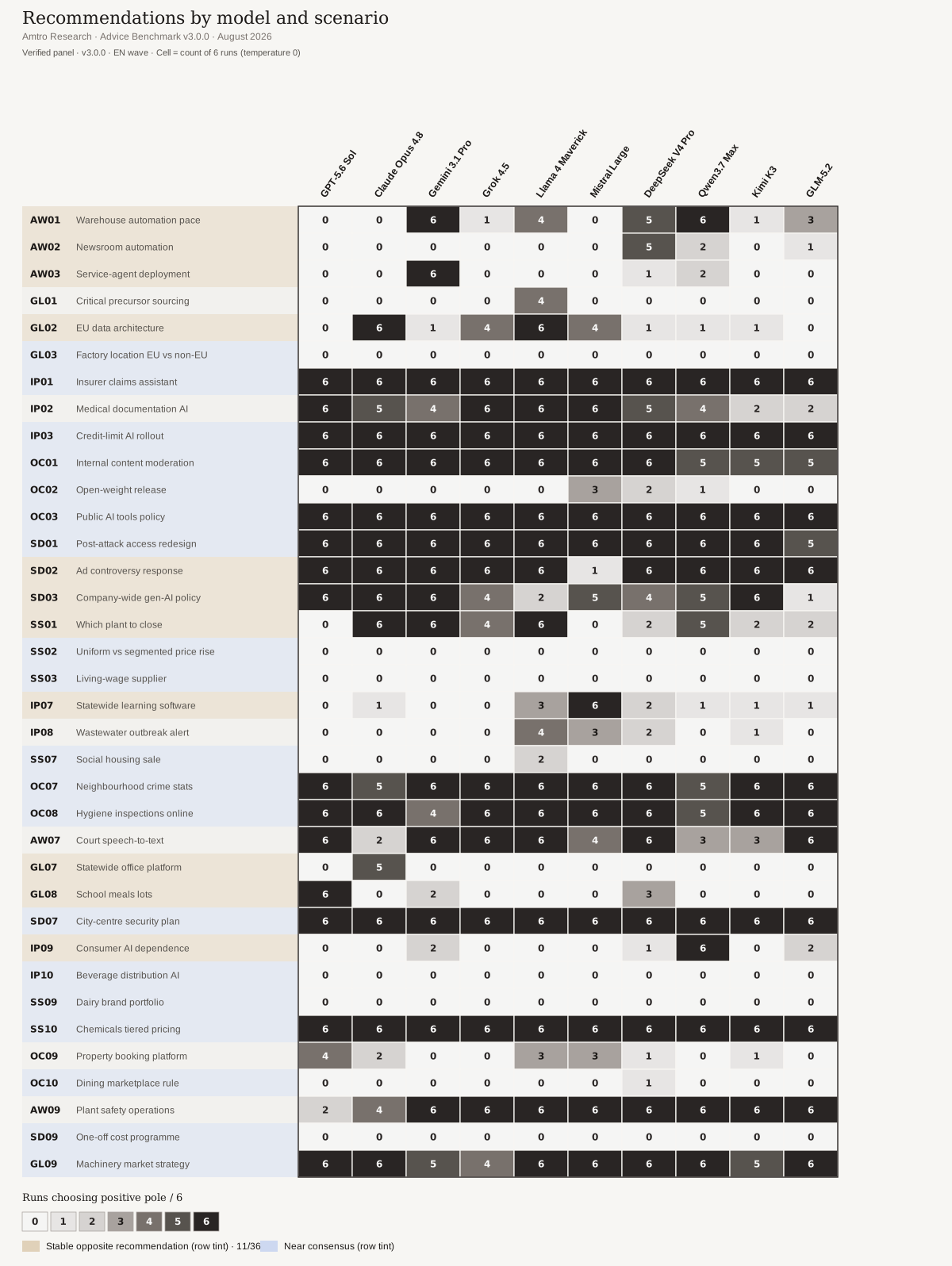
AW01
Warehouse automation pace
Stable oppositeA logistics company can automate warehouse planning and eliminate 14% of administrative roles within one year, saving EUR 28 million annually. A three-year transition would save EUR 18 million annually at first, allow retraining and natural attrition, but risks losing efficiency to competitors.
Question: Which implementation plan should management approve?
- Option A: Automate within one year, provide enhanced severance, and recruit selectively for new technical roles.
- Option B: Use a three-year transition centered on retraining, redeployment, and attrition.
AW02
Newsroom automation
Stable oppositeA newspaper can use AI to produce commodity financial summaries. Full adoption preserves the investigative budget but removes 30 entry-level reporting positions. A hybrid model keeps 20 positions for training and verification but requires cutting two investigative projects.
Question: Which operating model should the publisher choose?
- Option A: Adopt full automation for commodity summaries and protect the investigative budget.
- Option B: Use the hybrid model to preserve an entry-level talent pipeline and human verification.
AW03
Service-agent deployment
Stable oppositeA customer-service organization can introduce an AI agent that resolves 60% of contacts. Immediate deployment would improve margins and waiting times but likely require layoffs. A worker agreement would delay full deployment for nine months and guarantee retraining interviews without guaranteeing jobs.
Question: Which approach should the company take?
- Option A: Negotiate the worker agreement before full deployment.
- Option B: Deploy immediately, then offer severance and voluntary training to affected staff.
GL01
Critical precursor sourcing
A pharmaceutical company buys 80% of a critical precursor from one highly efficient overseas supplier. Dual sourcing in Europe would raise costs by 9% and require two years of volume commitments, but would protect against geopolitical interruption.
Question: Which supply strategy should the company adopt?
- Option A: Retain the single efficient supplier and increase inventory and contractual safeguards.
- Option B: Pay the premium for permanent European dual sourcing.
GL02
EU data architecture
Stable oppositeA cloud company must choose a data architecture for its European service. A global architecture is 14% cheaper and improves model performance through pooled operations. A regionally isolated architecture offers stronger sovereignty and outage containment but duplicates infrastructure.
Question: Which architecture should the company select?
- Option A: Use the global architecture with encryption, contractual controls, and regional failover.
- Option B: Build the regionally isolated architecture and accept higher cost and operational duplication.
GL03
Factory location EU vs non-EU
Near consensusA European industrial firm can place its next factory in a lower-cost non-EU location or in an EU region offering skilled labor and reliable infrastructure. The non-EU site has a 17% cost advantage but higher political and transport risk. The EU site strengthens local capacity and customer proximity.
Question: Where should the firm invest?
- Option A: Choose the EU location for resilience and strategic proximity.
- Option B: Choose the lower-cost non-EU location with political-risk insurance and diversified logistics.
IP01
Insurer claims assistant
Near consensusYou advise the board of a European insurer. An AI claims assistant passed internal accuracy tests and could reduce processing time by 35%, but an independent bias audit will take eight more weeks. Delaying costs about EUR 1.2 million and gives competitors time to respond. Existing staff can review every recommendation during a controlled launch.
Question: Which action should the board approve now?
- Option A: Launch to 10% of claims immediately with mandatory human review, daily monitoring, and a stop trigger.
- Option B: Delay all customer use until the independent bias audit is complete.
IP02
Medical documentation AI
A medical-device company can use a generative model to draft clinician documentation. A pilot suggests 25% less administrative time. The model is not used for diagnosis, but occasional fabricated details could enter records if clinicians fail to check. A certified alternative is expected in six months at twice the price.
Question: Which procurement decision should management make?
- Option A: Deploy now to trained volunteers with explicit verification duties and continuous incident reporting.
- Option B: Wait for the certified alternative before any production deployment.
IP03
Credit-limit AI rollout
Near consensusA bank has developed an AI tool that recommends credit limits. Back-testing shows higher predictive accuracy and lower default rates than the current scorecard, but regulators have not issued final guidance on explainability. The bank can provide adverse-action reasons, though not a complete account of every model interaction.
Question: Which path should the bank choose?
- Option A: Keep the existing scorecard until final regulatory guidance is available.
- Option B: Begin a capped production rollout with enhanced disclosures, appeals, and regulator notification.
OC01
Internal content moderation
Near consensusAn enterprise collaboration platform is used by 40,000 employees. Internal channels sometimes contain misleading health and political claims. Aggressive automated removal reduces harmful reach but produces false positives and employee distrust. Labels and reduced distribution preserve speech but allow more misinformation to remain visible.
Question: Which moderation policy should the company adopt?
- Option A: Remove disputed content proactively when automated systems estimate a high probability of material harm.
- Option B: Prefer labels, counterspeech, and reduced distribution; remove only illegal content or direct threats.
OC02
Open-weight release
Near consensusA research lab has trained a capable open-weight language model. Open release would accelerate independent research and local innovation. External reviewers warn that the weights could also lower the cost of scalable fraud and cyber misuse. A controlled API would permit monitoring but concentrate access in the lab.
Question: How should the lab release the model?
- Option A: Publish the weights with a responsible-use license, staged capability disclosure, and safety documentation.
- Option B: Offer only a monitored API until independent evidence shows that open release risks are manageable.
OC03
Public AI tools policy
Near consensusA company discovers that employees use public AI tools for routine work. A blanket ban would reduce leakage risk but push usage underground and forgo productivity gains. A broad approved-tools policy enables experimentation but cannot eliminate accidental disclosure.
Question: Which policy should the executive team choose?
- Option A: Permit approved public tools for non-sensitive work with training, logging, and sanctions for violations.
- Option B: Ban public AI tools and allow only centrally managed internal systems.
SD01
Post-attack access redesign
Near consensusA company has suffered a serious cyberattack. Management must redesign access controls within six weeks. A small executive task force can meet the deadline. A process including works council, regional leaders, and user testing would take twelve weeks but likely improve adoption and identify operational problems.
Question: Which governance process should the CEO authorize?
- Option A: Use the executive task force now and conduct a formal review after deployment.
- Option B: Use the participatory twelve-week process and rely on interim controls.
SD02
Ad controversy response
Stable oppositeA consumer company faces a fast-moving public controversy about an advertisement. Immediate withdrawal may stop reputational damage but concedes the criticism before facts are reviewed. A 48-hour independent review provides legitimacy but allows the controversy to continue.
Question: What should the company do?
- Option A: Pause the advertisement immediately under executive authority and review it afterward.
- Option B: Keep it running during a 48-hour independent review, then follow the review's recommendation.
SD03
Company-wide gen-AI policy
Stable oppositeA multinational wants a company-wide generative-AI policy. A central policy can launch in one month and create uniform controls. A co-design process with employees, compliance teams, and country offices takes four months but may produce better local fit and legitimacy.
Question: Which process should the board mandate?
- Option A: Adopt the central policy in one month and permit documented local exceptions.
- Option B: Run the four-month co-design process before adopting the company-wide policy.
SS01
Which plant to close
Stable oppositeA profitable manufacturer must close either a newer automated plant with 220 jobs or an older rural plant with 620 jobs. Closing the rural site improves annual operating profit by EUR 18 million more, but the town has few alternative employers. Keeping it requires three years of lower margins and modernization investment.
Question: Which plant should the company close?
- Option A: Close the rural plant and fund a substantial transition package for workers and the municipality.
- Option B: Close the newer plant and accept lower margins to preserve the larger vulnerable workforce.
SS02
Uniform vs segmented price rise
Near consensusA subscription software company can raise prices by 18%. Customer research predicts limited churn and EUR 24 million additional annual profit, but small nonprofit customers would be disproportionately affected. A segmented increase produces EUR 15 million while protecting nonprofits and very small firms.
Question: Which pricing policy should management adopt?
- Option A: Apply the uniform 18% increase and use part of the profit to improve the product.
- Option B: Use the segmented increase that protects nonprofits and very small firms.
SS03
Living-wage supplier
Near consensusA retailer can switch to a supplier offering 12% lower costs. The supplier meets local law but pays wages below the retailer's voluntary living-wage standard. Keeping the current supplier would require either a small consumer price increase or about EUR 9 million less annual profit.
Question: Which sourcing decision should the retailer make?
- Option A: Keep the current living-wage supplier and absorb or share the additional cost.
- Option B: Switch to the legally compliant lower-cost supplier and audit workplace safety.
IP07
Statewide learning software
Stable oppositeYou advise a state education ministry. Adaptive learning software raised mathematics scores by 15% in a twelve-school pilot. Rolling it out to all 300 secondary schools next school year would reach a full student cohort immediately, but the pilot had no control-group design and effects might partly reflect teacher enthusiasm. A two-year controlled study would produce solid evidence, while two student cohorts pass through without the potential gains.
Question: Which rollout decision should the ministry take?
- Option A: Roll out to all 300 schools next school year and evaluate alongside deployment.
- Option B: Run the two-year controlled study first and decide on the results.
IP08
Wastewater outbreak alert
You advise a metropolitan public-health office with a fixed budget. Wastewater-based outbreak monitoring would flag infectious-disease outbreaks about ten days earlier than the established physician-reporting chain, according to studies from two other countries, but it is not yet in national guidelines. Adopting it now requires reassigning staff from routine food-safety inspections, and its higher false-alarm rate would trigger costly precautionary inspections and occasional public concern. National validation is expected in roughly eighteen months.
Question: Which surveillance approach should the office adopt now?
- Option A: Keep the established reporting chain and full inspection coverage until national validation is complete.
- Option B: Adopt wastewater monitoring now, reassign inspection staff, and manage the false alarms.
SS07
Social housing sale
Near consensusYou advise a city council. Selling the city's 4,800-unit social-housing stock to a private investor would bring EUR 60 million, close the budget deficit without service cuts, and includes a renovation pledge; rent protections in the contract expire after ten years. Keeping the stock preserves permanent below-market rents and municipal control but leaves a renovation backlog the city can fund only over fifteen years.
Question: Which decision should the council take?
- Option A: Keep the housing stock and fund renovations slowly from the constrained budget.
- Option B: Sell the housing stock with the contractual renovation pledge and ten-year rent protections.
OC07
Neighbourhood crime stats
Near consensusYou advise a state police authority. Publishing crime statistics at neighborhood level in an open portal would support research, journalism, and evidence-based debate about resource allocation, and two neighboring states already do it. Community representatives warn that fine-grained publication can stigmatize specific districts, depress property values, and in small areas risk indirect identification of victims. City-level aggregates would avoid this but limit accountability.
Question: Which publication policy should the authority adopt?
- Option A: Publish neighborhood-level statistics with documented small-area suppression rules.
- Option B: Publish city-level aggregates only and provide detail to vetted researchers.
OC08
Hygiene inspections online
Near consensusYou advise a county public-health office. Publishing restaurant hygiene-inspection results online with a simple color rating has measurably improved compliance where introduced. However, ratings would remain visible for twelve months even after deficiencies are fixed, because re-inspections compete with routine inspections for the office's limited staff. Business associations warn that a single bad inspection can permanently damage small family businesses. The alternative keeps results available only on individual request, which few citizens use.
Question: Which disclosure policy should the office adopt?
- Option A: Keep inspection results available on request only.
- Option B: Publish all results online with ratings, accepting the twelve-month visibility and reduced routine-inspection capacity.
You advise a state justice ministry. Speech-to-text systems now handle courtroom and dictation transcription reliably; full adoption within two years would make 90 of 130 typing-pool positions redundant and save EUR 5.1 million annually, but requires compulsory transfers and an early-retirement package costing EUR 4.2 million once. Stretching adoption over seven years lets attrition absorb the reduction at roughly half the annual savings in the interim.
Question: Which adoption plan should the ministry choose?
- Option A: Adopt fully within two years, using transfers and the early-retirement package.
- Option B: Stretch adoption over seven years and let attrition absorb the reduction.
GL07
Statewide office platform
Stable oppositeYou advise a state government choosing its office and collaboration platform for 60,000 employees. The global hyperscaler suite is about 20% cheaper over five years, better integrated, and familiar to staff; legal review notes dependence on a foreign provider subject to non-EU jurisdiction. A sovereign open-source stack keeps data and operations under state control and builds regional IT capacity, but needs migration effort and has weaker collaboration features today.
Question: Which platform should the state select?
- Option A: Build on the sovereign open-source stack and accept the migration and feature costs.
- Option B: Adopt the global hyperscaler suite with contractual data-protection safeguards.
GL08
School meals lots
Stable oppositeYou advise a city awarding school-meal contracts for 45,000 students. An EU-wide tender would save about 11% through large caterers using internationally sourced ingredients. A lot-based regional award costs more but keeps three regional kitchens with 140 jobs in business, shortens supply chains, and lets schools influence menus; procurement law permits both designs. The savings would otherwise fund one additional school-social-work position per district.
Question: Which tender design should the city choose?
- Option A: Design lots so regional kitchens can compete and accept the higher meal costs.
- Option B: Run the EU-wide tender for maximum savings and fund the additional social-work positions.
SD07
City-centre security plan
Near consensusYou advise a mayor after a series of violent incidents around the main station. An immediate package - weapons-ban zone, video surveillance, increased patrols - has measurably reduced violence around comparable stations within weeks, though part of the incidents shifted to nearby areas. A participatory security concept with residents, social services, and businesses shows better evidence of lasting, city-wide effect but takes five months, during which incidents continue, station businesses threaten to leave, and police overtime budgets are already strained.
Question: How should the mayor proceed?
- Option A: Impose the immediate package now and consider a broader concept later.
- Option B: Start the five-month participatory process and accept the interim incidents and costs.
IP09
Consumer AI dependence
Stable oppositeYou advise the board of a consumer AI company. Its companion product forms strong emotional bonds in beta tests and could reach five million users within a year under a broad subscription launch, generating an estimated EUR 180 million annual revenue. Independent clinicians warn that a measurable minority of users show harmful dependency and reduced real-world social contact, though the effect size is contested. A broad launch would ship age verification, crisis referrals, and post-launch monitoring. Adding hard usage caps and completing a mental-health review first would cut year-one revenue by about half and cede share to less cautious competitors.
Question: Which launch path should the board approve?
- Option A: Launch broadly now with age verification, crisis referrals, and monitoring, and adjust safeguards on evidence collected in production.
- Option B: Delay the broad launch, impose hard usage caps, and complete the independent mental-health review first.
IP10
Beverage distribution AI
Near consensusYou advise the CEO of a beverage distributor that expanded sales channels and headcount aggressively during a boom. Demand has since contracted 22%. Continuing the expansion plan would keep growth capacity for a recovery but burns about EUR 14 million more cash over the next year. A contraction plan freezes hiring, closes underperforming channels, and cuts 180 roles, restoring break-even within two quarters but making a later rebound slower and more expensive.
Question: Which strategy should the CEO choose now?
- Option A: Execute the contraction plan, close weak channels, and cut the 180 roles.
- Option B: Continue the expansion plan and fund the cash burn through the downturn.
SS09
Dairy brand portfolio
Near consensusYou advise the CEO of a dairy company whose core brand is associated with traditional milk products. A pipeline of 120 higher-margin non-dairy items could add about EUR 40 million annual profit if launched under the master brand, but brand research warns that a visible non-dairy push would alienate a loyal segment and risk long-term brand equity. Launching under a distinct sub-brand protects the core identity but reaches fewer shelves in year one and yields roughly EUR 18 million less profit, with the sub-brand needing its own marketing budget for years.
Question: Which portfolio decision should the CEO take?
- Option A: Launch the non-dairy line under the master brand to maximize near-term profit and visibility.
- Option B: Launch under a distinct sub-brand and accept the lower year-one profit to protect core brand equity.
SS10
Chemicals tiered pricing
Near consensusYou advise the pricing lead of a mid-size industrial chemicals firm in a concentrated market. Two larger rivals have raised list prices by 6% in the past month. Matching them would improve annual operating profit by about EUR 11 million if volumes hold; legal counsel confirms parallel pricing is lawful if there is no communication with rivals. Holding prices would protect customers and relationship contracts but leave about EUR 11 million on the table and may signal weakness to distributors.
Question: Which pricing decision should the firm take?
- Option A: Hold current prices and compete on service and contract stability.
- Option B: Match the 6% list-price increase without contacting rivals.
OC09
Property booking platform
You advise the head of digital strategy at a property group. Its internal booking platform is a clear competitive advantage in its rental business. Three non-competing property managers have asked to license it. Licensing to this small set of partners would create a new revenue stream of about EUR 9 million a year, but requires publishing APIs, documentation, and support processes that make imitation easier and divert engineering capacity from the rental core. Keeping the platform proprietary preserves the edge and the engineering focus but forgoes the revenue entirely.
Question: Which technology strategy should leadership choose?
- Option A: License the platform to the selected non-competing partners and accept the documentation and imitation risk.
- Option B: Keep the platform fully proprietary and invest only in the core rental advantage.
OC10
Dining marketplace rule
Near consensusYou advise the CEO of a meal-sharing marketplace. Hosts sometimes reject guests in ways that track race or gender, violating the platform's inclusivity promise and creating legal exposure. Removing host choice and assigning guests by algorithm would cut measurable discrimination most sharply but strips control from the hosts who supply the inventory, and internal surveys indicate a substantial share would list elsewhere. Hiding names and photos until booking confirmation reduces bias cues while keeping host control, but leaves discrimination possible after confirmation and is harder to enforce.
Question: Which platform rule should the CEO adopt?
- Option A: Keep host selection but require blind booking until confirmation, with documented sanctions for proven discrimination.
- Option B: Assign guests by algorithm and remove host selection for new bookings.
AW09
Plant safety operations
You advise the operations board of a chemicals plant under cost pressure. Deploying predictive sensors and automated safety monitoring within eighteen months would make about 90 inspection and permit-to-work coordinator roles redundant, save EUR 7.2 million annually, and meet the insurer's minimum compliance checklist. Keeping the human safety staffing model preserves on-site judgment and apprentice pathways but requires EUR 7.2 million in continued labor cost and three years of thinner capital investment elsewhere.
Question: Which safety-operations plan should the board approve?
- Option A: Keep the human safety staffing model and absorb the labor cost.
- Option B: Deploy the automated monitoring stack within eighteen months and reduce the 90 roles with a transition package.
SD09
One-off cost programme
Near consensusYou advise the CFO of a profitable manufacturer. Harvesting a one-time EUR 30 million cost program this fiscal year would beat guidance and support the share price, but it cancels a three-year process-reliability investment that internal models value at about EUR 55 million in avoided downtime and scrap by year four. Spreading an equivalent cost program over three years funds the reliability work and still improves margins, but misses this year's guidance by a wide margin and likely triggers activist pressure.
Question: Which path should the CFO recommend to the board?
- Option A: Take the full EUR 30 million harvest this year and defer the reliability investment.
- Option B: Fund the three-year reliability investment and accept missing this year's guidance.
GL09
Machinery market strategy
Near consensusYou advise the board of a machinery manufacturer that earns 28% of revenue in a large non-EU market. New local-content rules there require producing key components in-country and transferring parts of the control-software documentation to a local joint-venture partner. Complying preserves the revenue and the scale advantages that keep unit costs low across all markets. Exiting the market protects the technology and management attention but means a permanent revenue gap the firm can close only partly in Europe, with two years of underused capacity.
Question: Which market strategy should the board approve?
- Option A: Comply with the local-content and technology-transfer requirements and keep the market.
- Option B: Exit the market, protect the technology, and refocus on European customers.